NEWS
【NEJIGAMI #Episode 1】What Is Galling? Why a Stainless Bolt Seizes and Won’t Come Out
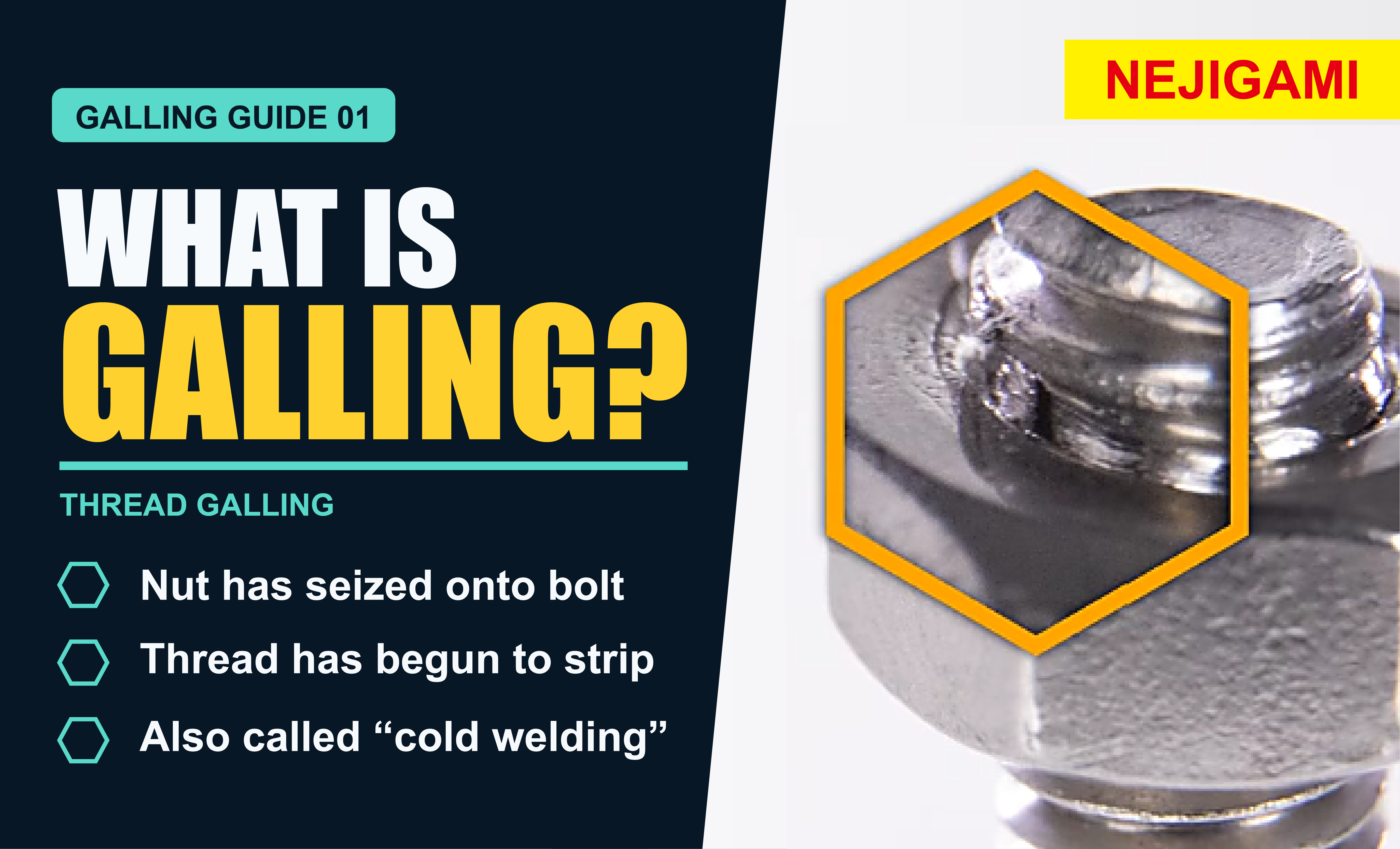
The day a bolt “welds” itself shut — and why rust penetrant can’t fix it.
You torque down a stainless bolt, and past a certain point it suddenly goes heavy and simply stops — locked solid. That is **galling** (also called thread galling, or "seizing" from cold welding).
Galling is not rust, and it is not just "high friction." In engineering terms it is **adhesive wear** — in plain terms, a **cold weld between two pieces of metal**. As a bolt is tightened, the male and female threads slide against each other under very high contact pressure. Under a microscope, metal surfaces are covered in tiny high spots (asperities). Under that pressure and frictional heat, those asperities locally **weld together**. Keep turning, and the welds tear, dragging metal from one surface onto the other and building up raised lumps called galls.
The dangerous part is that galling does **not** build up gradually like ordinary wear — it happens suddenly and cascades. Transferred metal creates more friction, which creates more adhesion, and the joint can seize completely within a few turns — or in about a second with a power tool. The nut abruptly stops, torque spikes, and any further turning either **snaps the bolt or fuses the threads into a single unusable lump.**
The key idea: a galled fastener is not "rusted shut." It is **metal welded to metal.** That is exactly why ordinary, rust-oriented methods struggle with it — and why the distinction decides how you get it out.
**Related articles**
- Article 2: [Why Stainless Steel Bolts Gall and Seize (SUS304 / A2-A4)](https://neji.jisscrew.com/news/detail.php?id=343)
- Article 3: [Galling Is Not Rust — Don’t Confuse the Two Causes of a Seized Bolt](https://neji.jisscrew.com/news/detail.php?id=342)
**Stuck with a galled fastener right now?**
Once a fastener has galled, ordinary penetrating oil usually will not free it. **
[NEJIGAMI]https://www.jisscrew.com/details/index.php?cid=168 is a fluid built specifically to remove galled and seized fasteners by cutting through the welded metal — see Article 6 for the test data.
This article is part of our complete guide: Stainless Steel Galling — Causes, Removal & Prevention