NEWS
2026/10/29Manufacturer
Complete guide: Stainless Steel Galling — Causes, Removal & Prevention
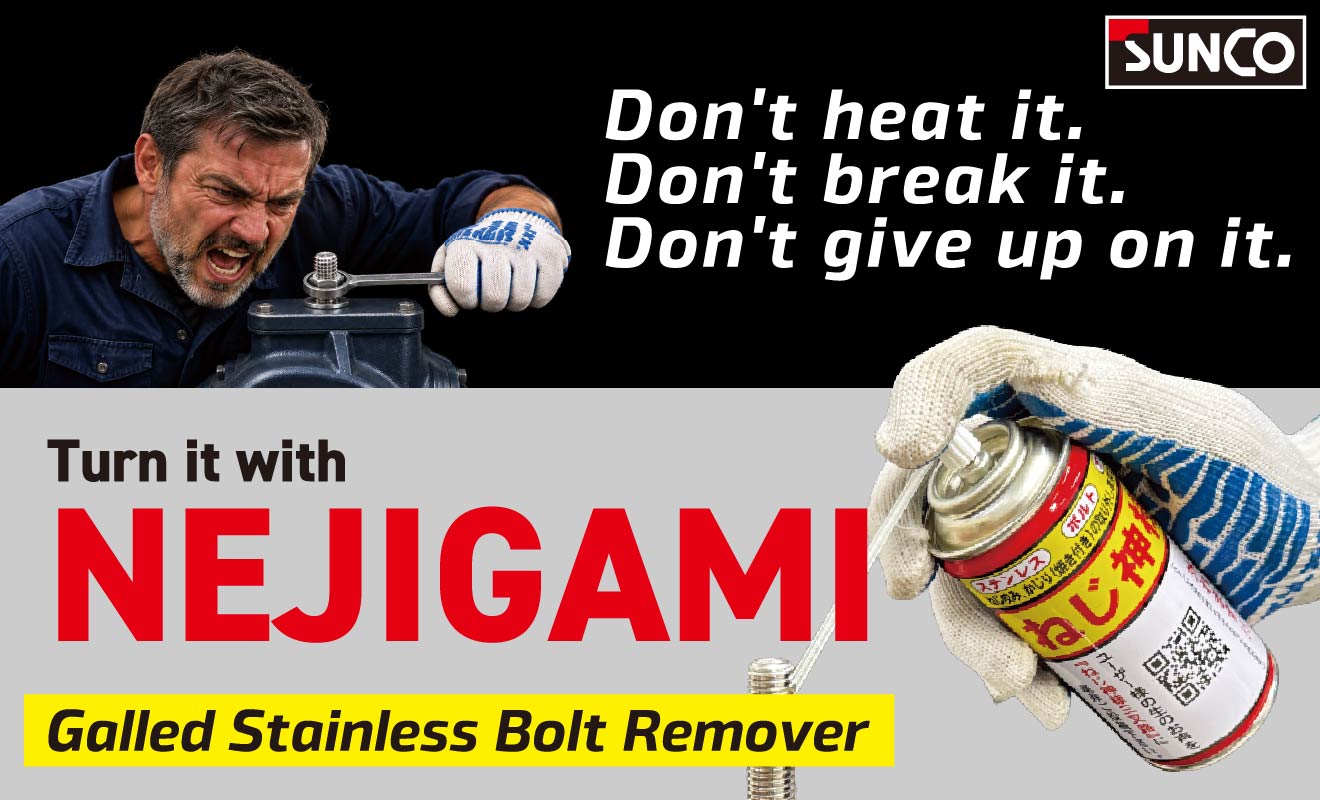
Stainless Steel Galling: Why Bolts Seize, How to Remove Them, and How to Prevent It
You are tightening a stainless steel bolt. Everything feels normal — then, within a single turn, the nut goes heavy and stops dead. It will not go forward, and it will not come back. The bolt has not rusted. It has **galled**: the threads have cold-welded to each other, and the joint is now, in effect, a single piece of metal.
Galling (also called thread galling, cold welding, or seizing) is the most common — and most misunderstood — failure when working with stainless steel fasteners. It is misunderstood because it looks like rust seizure, so it gets treated like rust seizure, with penetrating oil. That almost never works, and this guide explains why: what galling actually is, why stainless steel is so prone to it, how to tell galling from rust, how to remove a galled bolt without cutting it, and how to stop it happening in the first place.
What is galling?
Galling is a form of adhesive wear. When two metal surfaces slide against each other under high pressure — exactly what happens between a bolt thread and a nut thread during tightening — the microscopic high spots on those surfaces (asperities) are pressed together so hard that they locally **weld**. As tightening continues, those tiny welds tear. Metal is dragged from one surface onto the other, building up raised lumps of transferred material called *galls*.
Those lumps increase friction. More friction creates more adhesion, which creates more transferred metal. This is why galling does not develop gradually like ordinary wear: it **cascades**. A joint can go from turning freely to seized solid in a few revolutions — or in about a second, if a power tool is doing the turning. At that point, any additional torque does one of two things: the bolt snaps, or the threads fuse into a single unusable lump.
The key idea to hold on to: **a galled fastener is not "stuck." It is welded.** Every removal method that works by dissolving something, or by making surfaces slide more easily, fails against a weld — because there is nothing to dissolve, and welded metal does not slide.
Read the full article: What Is Galling? Why a Stainless Bolt Seizes and Won't Come Out
https://neji.jisscrew.com/news/detail.php?id=344
Why stainless steel galls so easily
Mechanics often say stainless seizes worse than plain steel. There are clear metallurgical reasons, and they all come back to austenitic stainless steel — grades 304 and 316, or A2 and A4 in fastener terms.
**1. The protective film is thin and easily broken.**
Stainless steel resists corrosion because of a thin passive oxide film on its surface. Under the contact pressure inside a thread, that film ruptures easily. The moment it breaks, bare metal is exposed — and that exposed spot is where adhesion starts.
**2. Bare stainless wants to stick.**
Freshly exposed stainless surfaces have a high affinity for adhesion. If the passive film is disrupted faster than it can re-form, cold welding begins almost immediately.
**3. Bolt and nut are usually the same material, at the same hardness.**
A stainless bolt is normally paired with a stainless nut of the same alloy. Neither surface is harder than the other, so instead of one surface shedding the load, the two dig into each other. Stainless is also ductile: damaged material does not chip away cleanly, it smears and piles up — which is textbook galling behavior.
On top of the material itself, four working conditions make galling far more likely:
- **High tightening torque** — more pressure on the thread flanks - **High tightening speed** — power tools and impact drivers generate friction heat fast - **Dry, unlubricated threads** — no barrier between the metal surfaces - **Dirt, burrs, or damaged threads** — ready-made starting points for adhesion Read the full article: Why Stainless Steel Bolts Gall and Seize (SUS304 / A2-A4)
https://neji.jisscrew.com/news/detail.php?id=343
Galling vs. rust: how to tell which one you have
"The bolt won't come out" can mean two completely different things, and confusing them means your very first move is wrong.
A simple field test: if a stainless bolt and nut **locked suddenly while being assembled** — turning freely one moment, solid the next — it is almost certainly galling, not rust. If a steel bolt has sat outdoors for years and is visibly corroded, it is almost certainly rust.
Read the full article: Galling Is Not Rust — Don't Confuse the Two Causes of a Seized Bolt
https://neji.jisscrew.com/news/detail.php?id=342
How to remove a galled stainless steel bolt
Work through these steps in order. The goal is to release the fastener **without cutting, drilling, or heat** — because every destructive method trades "it came out" for new costs: replacement parts, re-machining, damaged parent material, and time.
**Step 1 — Stop.**
The moment a stainless fastener suddenly goes heavy, stop turning. Galling cascades under load: more force means more welded material, and the usual end point is a snapped bolt or a bent shank — not a free one.
**Step 2 — Clean what you can reach.**
Brush dirt and debris from the exposed threads and the nut face. Contamination blocks any fluid from reaching the joint.
**Step 3 — Apply a fluid made for galling, not for rust.**
Spray a galling-removal fluid onto the joint so it reaches the thread engagement. NEJIGAMI is built for exactly this situation: instead of only penetrating and lubricating, it works into the near-zero clearance of a galled joint and progressively cuts away the cold-welded metal from within, breaking the bond itself. Allow it time to penetrate before turning.
**Step 4 — Work it back and forth, in small movements.**
Do not try to power it out in one direction. Tighten a fraction, loosen a fraction, and gradually increase the movement. Each small cycle lets the fluid reach further into the joint and breaks the weld down progressively rather than all at once.
**Step 5 — Reapply and repeat.**
If movement stalls, apply again and repeat Step 4. Patience here is what separates a bolt that comes out intact from one that shears.
**Step 6 — Know the last resorts, and their costs.**
If a fastener genuinely will not move, the remaining options are destructive: cutting with a grinder or cut-off wheel (fast, but sacrifices the part and risks collateral damage), drilling out and re-tapping (slow, and a wandering drill damages the parent material), a nut splitter (breaks the nut; the bolt is rarely reusable), or heat (expansion can help on some joints, but risks burning nearby seals, plastics, wiring, and paint — and frequently does not release stainless galling anyway). Treat these as the end of the road, not the starting point.
**After removal:**never reuse a galled bolt or nut. The thread surfaces are torn and piled with transferred metal, and a damaged fastener is a galling incident waiting to repeat itself. Inspect the tapped hole or mating thread, and repair it if it shows the same damage. Read the full article: How to Remove a Galled / Seized Stainless Bolt Without Cutting or Heat
https://neji.jisscrew.com/news/detail.php?id=340
Why penetrating oil won't free a galled bolt
"I sprayed a famous penetrant over and over, and the stainless bolt still won't budge" is a story every experienced mechanic recognizes. The reason is mechanical, not a matter of brand:
1. **There is nothing to dissolve.**A penetrating oil is formulated to dissolve rust and creep into the gap rust creates. Galling has no rust — it is solid, welded metal.
2. **There is no gap to penetrate.**In a galled joint, metal has dug into metal with essentially zero clearance. With no path in, the oil sits on the surface.
3. **Lubrication cannot break a weld.**All a penetrant can do is help surfaces slide. No amount of "slide" separates two pieces of metal that have fused into one.
This is not theory. In our testing, ordinary penetrating oils could not reliably free a galled stainless bolt. A globally known penetrant freed none at all; even a product made specifically for stainless galling, and another well-known penetrant, moved only the occasional bolt — and only with prolonged effort and high torque that bent, sheared, or stripped the threads. A fluid designed to cut the weld itself removed every bolt it was tested on, without bending or breakage.
Read the full article: Why Penetrating Oil Won't Free a Galled Bolt
https://neji.jisscrew.com/news/detail.php?id=341
The test: NEJIGAMI against 10 other penetrants
We deliberately galled stainless steel bolts and nuts, then tested whether each product could actually remove them.
Test conditions.Specimens were stainless steel hex bolts, M12 × 50, with M12 stainless nuts (treated as A2-70 equivalent; not certified stock). Each joint was pre-galled until it would not move at 70% or more of the 84.0 N·m fracture torque (≥ 58.8 N·m). Every product was then applied under an identical procedure: spray → wait 15 seconds → measure the break-away torque → attempt removal with a box wrench. If it did not come loose, the product was re-applied up to twice more (three applications maximum), with a two-minute working limit. Round 1 (screening) tested all 12 conditions, 3 bolts each; Round 2 (finals) tested the top four products, 5 bolts each. Only observed results were recorded.
Round 1 — screening (12 conditions, 3 bolts each)
• NEJIGAMI was the only product that freed every bolt — aerosol 3/3, undiluted 3/3.
• The other well-known penetrants — both global and Japanese market leaders — freed none (0/3).
• Only one product marketed specifically for stainless galling freed even a single bolt (1/3).
Round 2 — finals (top 4 products, 5 bolts each)
Across the finals, the initial galling torque averaged 76.1–78.7 N·m.
What the test shows — the real difference is how it comes off. The other products either did not move, moved but would not release, or released only by being forced until they bent, sheared, or lost thread. NEJIGAMI, by contrast, began moving at a break-away torque (avg. 66.9 N·m) below the initial galling torque (avg. 78.7 N·m) — and came out intact. Across screening and finals combined, NEJIGAMI removed all 11 bolts it was tested on (8 aerosol, 3 undiluted) — none bent, none broken.
See the head-to-head test: Seized Bolt Remover That Works When Penetrants Fail — NEJIGAMI
https://neji.jisscrew.com/news/detail.php?id=339
How to prevent stainless steel galling
Once you understand the mechanism, prevention follows directly from it:
- **Lubricate, every time.** Apply anti-seize compound or a suitable lubricant to stainless threads before assembly. A barrier between the surfaces prevents metal-to-metal contact — the starting point of every galling incident. Remember that lubrication changes friction: follow the lubricant manufacturer's guidance on reduced tightening torque.
- **Slow down.** Hand-start every stainless fastener, run it down slowly, and finish by hand where possible. Avoid impact drivers and high-speed power tools on stainless; speed is friction heat, and friction heat is adhesion.
- **Pair dissimilar grades or hardnesses.** A 304 bolt with a 316 nut, or a nut of deliberately different hardness, galls less readily than identical material on identical material. Coated fasteners and purpose-designed anti-galling nuts apply the same principle at the surface.
- **Keep threads clean and undamaged.** Inspect for burrs, nicks, and debris before assembly, and hand-start to confirm the threads are properly engaged — never use the bolt to pull misaligned parts together.
- **Use the specified torque — no more.** Over-torquing does not make a joint safer; on stainless, it makes galling more likely.
- **Never reuse a damaged fastener.** Any bolt or nut that has begun to gall has torn thread surfaces. It goes in the scrap bin, not back into the next assembly.
Frequently asked questions
**What is thread galling?**
Thread galling is adhesive wear between mating threads: under pressure and friction, microscopic high spots on the thread surfaces cold-weld together, tear, and transfer metal from one surface to the other until the joint seizes. It is most common in stainless steel fasteners.
**Why do stainless steel bolts seize during tightening?**
Because stainless's protective oxide film breaks easily under thread pressure, the exposed metal adheres readily, and bolt and nut are usually the same alloy and hardness — so the surfaces dig into each other instead of sliding. High torque, high tightening speed, and dry threads make it worse.
**Can penetrating oil remove a galled bolt?**
Almost never, once galling is established. Penetrating oil dissolves rust and lubricates; a galled joint contains no rust, has essentially no gap for oil to enter, and is held by a metallic weld that lubrication cannot break. In our comparison test, the well-known penetrants freed none of the galled bolts, and even a stainless-galling specialist product managed only a few — and only by forcing them until they bent or broke.
**Can a galled stainless bolt be removed without cutting it?**
Yes — if the welded metal inside the joint is broken down first. A removal fluid designed for galling (such as NEJIGAMI) penetrates the joint and cuts away the cold-welded material, after which the fastener can be worked out gradually, back and forth. If that fails, cutting, drilling out, or splitting the nut remain as destructive last resorts.
**Should I reuse a bolt or nut that has galled?**
No. Galling tears the thread surfaces and leaves transferred metal piled on them. Reusing the fastener invites the same seizure to happen again, usually worse.
**How do I prevent stainless fasteners from galling?**
Lubricate the threads with anti-seize, tighten slowly (by hand where possible), use the specified torque, keep threads clean and undamaged, and where practical pair different stainless grades for bolt and nut. Prevention costs a tube of anti-seize; failure costs a seized or snapped bolt in a finished assembly.
Stuck with a galled fastener right now?
If penetrating oil has already failed on it, the problem is the weld — and the weld is what has to be removed. NEJIGAMI was developed for exactly that job: freeing galled stainless bolts and nuts without cutting the part, splitting the nut, or applying heat.
**[NEJIGAMI]** is built to remove galled stainless bolts and nuts. https://www.jisscrew.com/details/index.php?cid=168
You are tightening a stainless steel bolt. Everything feels normal — then, within a single turn, the nut goes heavy and stops dead. It will not go forward, and it will not come back. The bolt has not rusted. It has **galled**: the threads have cold-welded to each other, and the joint is now, in effect, a single piece of metal.
Galling (also called thread galling, cold welding, or seizing) is the most common — and most misunderstood — failure when working with stainless steel fasteners. It is misunderstood because it looks like rust seizure, so it gets treated like rust seizure, with penetrating oil. That almost never works, and this guide explains why: what galling actually is, why stainless steel is so prone to it, how to tell galling from rust, how to remove a galled bolt without cutting it, and how to stop it happening in the first place.
What is galling?
Galling is a form of adhesive wear. When two metal surfaces slide against each other under high pressure — exactly what happens between a bolt thread and a nut thread during tightening — the microscopic high spots on those surfaces (asperities) are pressed together so hard that they locally **weld**. As tightening continues, those tiny welds tear. Metal is dragged from one surface onto the other, building up raised lumps of transferred material called *galls*.
Those lumps increase friction. More friction creates more adhesion, which creates more transferred metal. This is why galling does not develop gradually like ordinary wear: it **cascades**. A joint can go from turning freely to seized solid in a few revolutions — or in about a second, if a power tool is doing the turning. At that point, any additional torque does one of two things: the bolt snaps, or the threads fuse into a single unusable lump.
The key idea to hold on to: **a galled fastener is not "stuck." It is welded.** Every removal method that works by dissolving something, or by making surfaces slide more easily, fails against a weld — because there is nothing to dissolve, and welded metal does not slide.
Read the full article: What Is Galling? Why a Stainless Bolt Seizes and Won't Come Out
https://neji.jisscrew.com/news/detail.php?id=344
Why stainless steel galls so easily
Mechanics often say stainless seizes worse than plain steel. There are clear metallurgical reasons, and they all come back to austenitic stainless steel — grades 304 and 316, or A2 and A4 in fastener terms.
**1. The protective film is thin and easily broken.**
Stainless steel resists corrosion because of a thin passive oxide film on its surface. Under the contact pressure inside a thread, that film ruptures easily. The moment it breaks, bare metal is exposed — and that exposed spot is where adhesion starts.
**2. Bare stainless wants to stick.**
Freshly exposed stainless surfaces have a high affinity for adhesion. If the passive film is disrupted faster than it can re-form, cold welding begins almost immediately.
**3. Bolt and nut are usually the same material, at the same hardness.**
A stainless bolt is normally paired with a stainless nut of the same alloy. Neither surface is harder than the other, so instead of one surface shedding the load, the two dig into each other. Stainless is also ductile: damaged material does not chip away cleanly, it smears and piles up — which is textbook galling behavior.
On top of the material itself, four working conditions make galling far more likely:
- **High tightening torque** — more pressure on the thread flanks - **High tightening speed** — power tools and impact drivers generate friction heat fast - **Dry, unlubricated threads** — no barrier between the metal surfaces - **Dirt, burrs, or damaged threads** — ready-made starting points for adhesion Read the full article: Why Stainless Steel Bolts Gall and Seize (SUS304 / A2-A4)
https://neji.jisscrew.com/news/detail.php?id=343
Galling vs. rust: how to tell which one you have
"The bolt won't come out" can mean two completely different things, and confusing them means your very first move is wrong.
| Rust seizure | Galling | |
|---|---|---|
| Cause | Corrosion: iron oxide forms and packs into the threads | Cold welding: thread surfaces fuse to each other |
| Typical fastener | Carbon steel, outdoors or in wet conditions | Stainless steel (also aluminum, titanium), often stainless-on-stainless |
| When it happens | Over months or years in service | Suddenly, during tightening or removal |
| What frees it | Dissolving the rust and lubricating — standard penetrating oil is made for this | Cutting through the welded metal itself; there is no rust to dissolve |
https://neji.jisscrew.com/news/detail.php?id=342
How to remove a galled stainless steel bolt
Work through these steps in order. The goal is to release the fastener **without cutting, drilling, or heat** — because every destructive method trades "it came out" for new costs: replacement parts, re-machining, damaged parent material, and time.
**Step 1 — Stop.**
The moment a stainless fastener suddenly goes heavy, stop turning. Galling cascades under load: more force means more welded material, and the usual end point is a snapped bolt or a bent shank — not a free one.
**Step 2 — Clean what you can reach.**
Brush dirt and debris from the exposed threads and the nut face. Contamination blocks any fluid from reaching the joint.
**Step 3 — Apply a fluid made for galling, not for rust.**
Spray a galling-removal fluid onto the joint so it reaches the thread engagement. NEJIGAMI is built for exactly this situation: instead of only penetrating and lubricating, it works into the near-zero clearance of a galled joint and progressively cuts away the cold-welded metal from within, breaking the bond itself. Allow it time to penetrate before turning.
**Step 4 — Work it back and forth, in small movements.**
Do not try to power it out in one direction. Tighten a fraction, loosen a fraction, and gradually increase the movement. Each small cycle lets the fluid reach further into the joint and breaks the weld down progressively rather than all at once.
**Step 5 — Reapply and repeat.**
If movement stalls, apply again and repeat Step 4. Patience here is what separates a bolt that comes out intact from one that shears.
**Step 6 — Know the last resorts, and their costs.**
If a fastener genuinely will not move, the remaining options are destructive: cutting with a grinder or cut-off wheel (fast, but sacrifices the part and risks collateral damage), drilling out and re-tapping (slow, and a wandering drill damages the parent material), a nut splitter (breaks the nut; the bolt is rarely reusable), or heat (expansion can help on some joints, but risks burning nearby seals, plastics, wiring, and paint — and frequently does not release stainless galling anyway). Treat these as the end of the road, not the starting point.
**After removal:**never reuse a galled bolt or nut. The thread surfaces are torn and piled with transferred metal, and a damaged fastener is a galling incident waiting to repeat itself. Inspect the tapped hole or mating thread, and repair it if it shows the same damage. Read the full article: How to Remove a Galled / Seized Stainless Bolt Without Cutting or Heat
https://neji.jisscrew.com/news/detail.php?id=340
Why penetrating oil won't free a galled bolt
"I sprayed a famous penetrant over and over, and the stainless bolt still won't budge" is a story every experienced mechanic recognizes. The reason is mechanical, not a matter of brand:
1. **There is nothing to dissolve.**A penetrating oil is formulated to dissolve rust and creep into the gap rust creates. Galling has no rust — it is solid, welded metal.
2. **There is no gap to penetrate.**In a galled joint, metal has dug into metal with essentially zero clearance. With no path in, the oil sits on the surface.
3. **Lubrication cannot break a weld.**All a penetrant can do is help surfaces slide. No amount of "slide" separates two pieces of metal that have fused into one.
This is not theory. In our testing, ordinary penetrating oils could not reliably free a galled stainless bolt. A globally known penetrant freed none at all; even a product made specifically for stainless galling, and another well-known penetrant, moved only the occasional bolt — and only with prolonged effort and high torque that bent, sheared, or stripped the threads. A fluid designed to cut the weld itself removed every bolt it was tested on, without bending or breakage.
Read the full article: Why Penetrating Oil Won't Free a Galled Bolt
https://neji.jisscrew.com/news/detail.php?id=341
The test: NEJIGAMI against 10 other penetrants
We deliberately galled stainless steel bolts and nuts, then tested whether each product could actually remove them.
Test conditions.Specimens were stainless steel hex bolts, M12 × 50, with M12 stainless nuts (treated as A2-70 equivalent; not certified stock). Each joint was pre-galled until it would not move at 70% or more of the 84.0 N·m fracture torque (≥ 58.8 N·m). Every product was then applied under an identical procedure: spray → wait 15 seconds → measure the break-away torque → attempt removal with a box wrench. If it did not come loose, the product was re-applied up to twice more (three applications maximum), with a two-minute working limit. Round 1 (screening) tested all 12 conditions, 3 bolts each; Round 2 (finals) tested the top four products, 5 bolts each. Only observed results were recorded.
Round 1 — screening (12 conditions, 3 bolts each)
• NEJIGAMI was the only product that freed every bolt — aerosol 3/3, undiluted 3/3.
• The other well-known penetrants — both global and Japanese market leaders — freed none (0/3).
• Only one product marketed specifically for stainless galling freed even a single bolt (1/3).
Round 2 — finals (top 4 products, 5 bolts each)
Across the finals, the initial galling torque averaged 76.1–78.7 N·m.
| Product | Removed | Avg. break-away torque | Notes |
|---|---|---|---|
| NEJIGAMI | 5 / 5 | 66.9 N·m | Avg. 1.2 applications, avg. 59.2 sec. No bending or breakage. |
| Product A (stainless-galling specialist) | 2 / 5 | 72.5 N·m | Avg. 2.4 applications, avg. 161.5 sec. Of the 3 not removed, 2 sheared off under sustained high torque. |
| Product B (well-known penetrant) | 1 / 5 | 71.2 N·m | Avg. 2.2 applications; the one success took 163 sec. 3 of 5 bolts bent; the freed bolt had stripped threads. |
| Product C (globally known penetrant) | 0 / 5 | 75.2 N·m | Avg. 2.6 applications; no bolt removed. 2 of 5 bolts bent under force. |
https://neji.jisscrew.com/news/detail.php?id=339
How to prevent stainless steel galling
Once you understand the mechanism, prevention follows directly from it:
- **Lubricate, every time.** Apply anti-seize compound or a suitable lubricant to stainless threads before assembly. A barrier between the surfaces prevents metal-to-metal contact — the starting point of every galling incident. Remember that lubrication changes friction: follow the lubricant manufacturer's guidance on reduced tightening torque.
- **Slow down.** Hand-start every stainless fastener, run it down slowly, and finish by hand where possible. Avoid impact drivers and high-speed power tools on stainless; speed is friction heat, and friction heat is adhesion.
- **Pair dissimilar grades or hardnesses.** A 304 bolt with a 316 nut, or a nut of deliberately different hardness, galls less readily than identical material on identical material. Coated fasteners and purpose-designed anti-galling nuts apply the same principle at the surface.
- **Keep threads clean and undamaged.** Inspect for burrs, nicks, and debris before assembly, and hand-start to confirm the threads are properly engaged — never use the bolt to pull misaligned parts together.
- **Use the specified torque — no more.** Over-torquing does not make a joint safer; on stainless, it makes galling more likely.
- **Never reuse a damaged fastener.** Any bolt or nut that has begun to gall has torn thread surfaces. It goes in the scrap bin, not back into the next assembly.
Frequently asked questions
**What is thread galling?**
Thread galling is adhesive wear between mating threads: under pressure and friction, microscopic high spots on the thread surfaces cold-weld together, tear, and transfer metal from one surface to the other until the joint seizes. It is most common in stainless steel fasteners.
**Why do stainless steel bolts seize during tightening?**
Because stainless's protective oxide film breaks easily under thread pressure, the exposed metal adheres readily, and bolt and nut are usually the same alloy and hardness — so the surfaces dig into each other instead of sliding. High torque, high tightening speed, and dry threads make it worse.
**Can penetrating oil remove a galled bolt?**
Almost never, once galling is established. Penetrating oil dissolves rust and lubricates; a galled joint contains no rust, has essentially no gap for oil to enter, and is held by a metallic weld that lubrication cannot break. In our comparison test, the well-known penetrants freed none of the galled bolts, and even a stainless-galling specialist product managed only a few — and only by forcing them until they bent or broke.
**Can a galled stainless bolt be removed without cutting it?**
Yes — if the welded metal inside the joint is broken down first. A removal fluid designed for galling (such as NEJIGAMI) penetrates the joint and cuts away the cold-welded material, after which the fastener can be worked out gradually, back and forth. If that fails, cutting, drilling out, or splitting the nut remain as destructive last resorts.
**Should I reuse a bolt or nut that has galled?**
No. Galling tears the thread surfaces and leaves transferred metal piled on them. Reusing the fastener invites the same seizure to happen again, usually worse.
**How do I prevent stainless fasteners from galling?**
Lubricate the threads with anti-seize, tighten slowly (by hand where possible), use the specified torque, keep threads clean and undamaged, and where practical pair different stainless grades for bolt and nut. Prevention costs a tube of anti-seize; failure costs a seized or snapped bolt in a finished assembly.
Stuck with a galled fastener right now?
If penetrating oil has already failed on it, the problem is the weld — and the weld is what has to be removed. NEJIGAMI was developed for exactly that job: freeing galled stainless bolts and nuts without cutting the part, splitting the nut, or applying heat.
**[NEJIGAMI]** is built to remove galled stainless bolts and nuts. https://www.jisscrew.com/details/index.php?cid=168