NEWS
【NEJIGAMI #Episode 6】When Penetrating Lubricants Fail: NEJIGAMI as the Last Resort for Galled Bolts
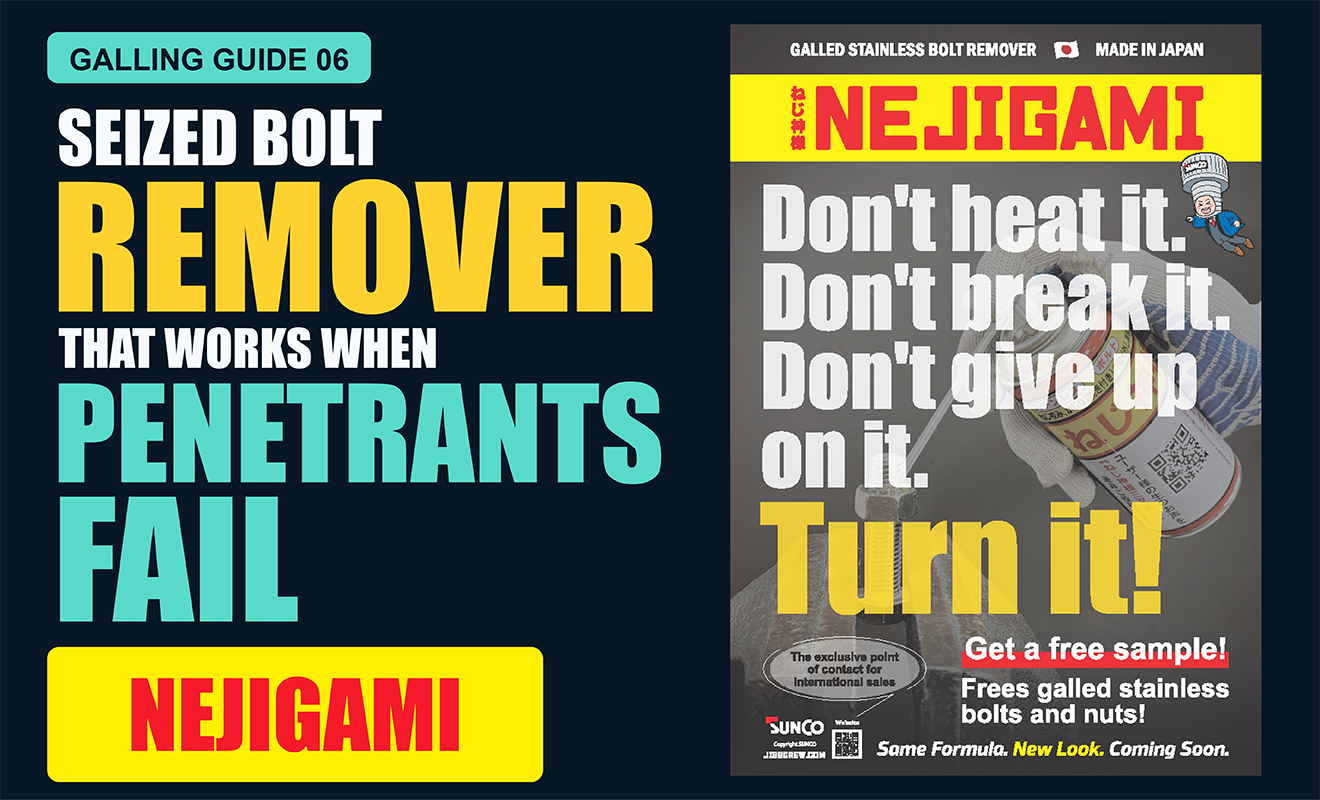
Can a severely galled bolt be removed before cutting or heating?
Conclusion: In this in-house comparison test, NEJIGAMI was the only product that completely removed every specimen in both the preliminary and final rounds. In the final round, it removed all five specimens without visible bending or fracture.
Can a Severely Galled Bolt Be Removed Before Cutting or Heating?
Stainless steel bolts and nuts can gall or seize when they are tightened firmly or forced to turn.
Galling is different from ordinary rust. It occurs when the threads rub strongly against each other, causing parts of the metal surfaces to stick together in a state similar to welding.
For this reason, ordinary penetrating lubricants intended mainly to lubricate rusted fasteners may not provide sufficient results on severely galled threads.
NEJIGAMI is a removal fluid developed to address galling and seizure in stainless steel fasteners.
In this in-house comparison test, we intentionally prepared severely galled stainless steel bolts and compared whether NEJIGAMI and other products could remove them completely.
How NEJIGAMI Differs from Ordinary Penetrating Lubricants
Ordinary penetrating lubricants enter small gaps between threads and reduce friction through lubrication.
NEJIGAMI is designed to enter the extremely small gaps in a galled joint and gradually cut away the metal contact points causing the seizure.
Its purpose is not simply to make the threads slide more easily. It is designed to act directly on the strongly seized metal contact points.
Test Method
Test Specimens
- Stainless steel hexagon bolt, M12 × 50
- Stainless steel hexagon nut, M12
For this test, the assumed fracture torque of an M12 bolt was set at 84.0 N·m.
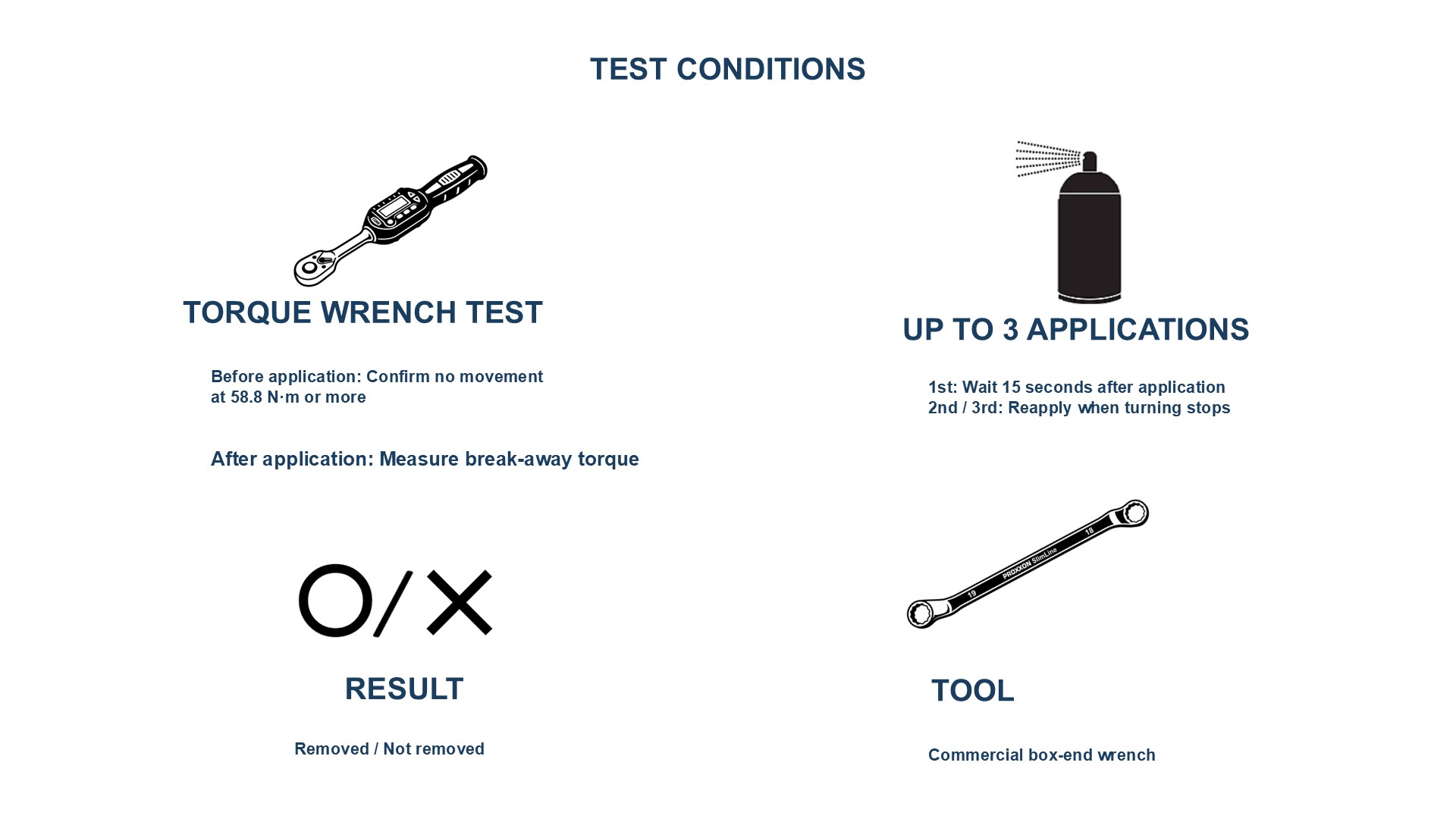
A specimen was treated as severely galled when the nut did not move even after a torque of at least 58.8 N·m, equivalent to 70% of 84.0 N·m, was applied.
Basic Test Procedure
- Use a torque wrench to confirm that the nut does not move at 58.8 N·m or more.
- Apply the test fluid.
- Wait for 15 seconds.
- Measure the break-away torque when the nut first begins to move.
- Change to a box-end wrench and attempt to remove the nut completely.
- If necessary, apply the test fluid up to three times in total.
- Record the removal result, working time, number of applications, deformation, fracture and thread condition.
The test consisted of two stages: a preliminary round comparing all products and a final round examining four selected products in greater detail.
Test Products and Comparison Results
Products Included in the Preliminary Round
The preliminary round compared NEJIGAMI in aerosol and undiluted liquid forms with 10 other products sold in Japan and overseas. The actual product names are not shown. Instead, each comparison product is given a simple nickname based on its packaging and product description.
| Test Condition | Nickname Used in This Article |
|---|---|
| NEJIGAMI Aerosol | Stainless Galling Remover |
| NEJIGAMI Undiluted Liquid | Stainless Galling Remover |
| Product A | Well-Known Overseas Penetrating Lubricant |
| Product B | Freeze-Type Penetrant 1 |
| Product C | Freeze-Type Penetrant 2 |
| Product D | Product Promoted for Stainless Galling |
| Product E | Seized-Fastener Removal Product |
| Product F | Well-Known Professional Penetrating Lubricant in Japan |
| Product G | Screw-Loosening Penetrant |
| Product H | Freeze-Type Penetrant 3 |
| Product I | Widely Used Japanese Penetrating Lubricant |
| Product J | Penetrating and Rust-Preventive Lubricant |
NEJIGAMI and Product D are both presented as products for stainless steel galling and seizure. Product E is presented as a product for seized fasteners, but the target metal is not specified.
The packaging or product descriptions for Products A, B, C and H mention use on rusted fasteners or rust-seized parts. However, some products are presented for broader use and are not clearly shown as being limited to rust-related applications.
The remaining products are widely used for loosening stuck screws or for general penetration, lubrication and rust prevention.
These product categories are based on the packaging and product information available when the test was conducted.
Preliminary-Round Results
- 11 products and 12 test conditions
- Three specimens per condition
- 36 specimens in total
- Maximum working time of two minutes per specimen
| Test Condition | Removal Result | Average Break-Away Torque | Average Removal Time |
|---|---|---|---|
| NEJIGAMI Aerosol Stainless Galling Remover | 3/3 | 66.3 N·m | 44.3 seconds |
| NEJIGAMI Undiluted Liquid Stainless Galling Remover | 3/3 | 56.7 N·m | 27.3 seconds |
| Product A Well-Known Overseas Penetrating Lubricant | 0/3 | 70.7 N·m | — |
| Product B Freeze-Type Penetrant 1 | 0/3 | 81.2 N·m | — |
| Product C Freeze-Type Penetrant 2 | 0/3 | 71.2 N·m | — |
| Product D Product Promoted for Stainless Galling | 1/3 | 57.8 N·m | 80.0 seconds |
| Product E Seized-Fastener Removal Product | 0/3 | 67.9 N·m | — |
| Product F Well-Known Professional Penetrating Lubricant in Japan | 0/3 | 70.1 N·m | — |
| Product G Screw-Loosening Penetrant | 0/3 | 65.7 N·m | — |
| Product H Freeze-Type Penetrant 3 | 0/3 | 74.3 N·m | — |
| Product I Widely Used Japanese Penetrating Lubricant | 0/3 | 73.4 N·m | — |
| Product J Penetrating and Rust-Preventive Lubricant | 0/3 | 74.1 N·m | — |
Removal Result shows the number completely removed out of the number tested. Average removal time was calculated only from specimens that were completely removed. A dash indicates that no specimen was removed.
What We Learned from the Preliminary Round
Both forms of NEJIGAMI removed all three specimens.
Among the comparison products, only Product D, which is promoted for stainless galling, removed one specimen. None of the other comparison products removed a specimen under these test conditions.
Some nuts treated with the comparison products began to move. However, movement did not always lead to complete removal. Some remained stuck, while some bolts bent during the attempt.
A nut beginning to move does not mean that it can be removed completely.
Final Round
Based on the preliminary results and the characteristics of the products, four products were selected for additional testing, with five specimens tested for each product.
| Test Condition | Product Type |
|---|---|
| NEJIGAMI | Stainless Galling Remover |
| Product A | Well-Known Overseas Penetrating Lubricant |
| Product D | Product Promoted for Stainless Galling |
| Product F | Well-Known Professional Penetrating Lubricant in Japan |
Product D was selected because, like NEJIGAMI, it is promoted for stainless steel galling. Products A and F were selected as examples of penetrating lubricants that are widely known and commonly chosen overseas or in Japan.
Five specimens were tested with each product, giving a total of 20 specimens. In the preliminary round, the working time was limited to two minutes per specimen. In the final round, testing continued beyond two minutes to determine whether each specimen could ultimately be removed.
Testing ended when removal was completed, the bolt fractured, or further work became impractical.
The average initial galling torque ranged from 76.1 to 78.7 N·m across the four products, indicating that they were tested under nearly identical initial conditions.
Final-Round Results
| Test Condition | Removal Result | Average Break-Away Torque | Average Removal Time | Condition After Testing |
|---|---|---|---|---|
| NEJIGAMI Stainless Galling Remover | 5/5 | 66.9 N·m | 59.2 seconds | No visible bending or fracture |
| Product A Well-Known Overseas Penetrating Lubricant | 0/5 | 75.2 N·m | — | Two bolts bent |
| Product D Product Promoted for Stainless Galling | 2/5 | 72.5 N·m | 161.5 seconds | Two unremoved bolts fractured |
| Product F Well-Known Professional Penetrating Lubricant in Japan | 1/5 | 71.2 N·m | 163.0 seconds | Three bolts bent; the successfully removed bolt also had missing threads |
Average removal time was calculated only from specimens that were successfully removed. Product D is based on two successful removals, while Product F is based on one.
What the Numbers Show
1. NEJIGAMI Removed All Five Specimens
NEJIGAMI removed all five specimens in the final round. Product A removed none, Product D removed two and Product F removed one. NEJIGAMI was the only product that removed every specimen in the final round.
2. NEJIGAMI Began Moving at a Lower Average Torque
The average break-away torque was 66.9 N·m for NEJIGAMI and 71.2 to 75.2 N·m for the comparison products. Under these test conditions, the nuts treated with NEJIGAMI began moving with less force.
3. Break-Away Torque Alone Does Not Show Whether Removal Will Succeed
The nuts treated with Products D and F also began to move. However, three of the five specimens treated with Product D and four of the five treated with Product F could not be removed completely.
A lower break-away torque alone does not prove that the fastener can be removed completely.
4. Two Bolts Treated with Product D Fractured
Product D removed two of the five specimens, but two of the three specimens that could not be removed fractured during the attempt.
The fractures are believed to have occurred because the bolts were subjected to enough load to break them. In comparison, NEJIGAMI removed all five specimens without visible bending or fracture.
5. There Was Also a Difference in Removal Time
- NEJIGAMI: Average 59.2 seconds, based on five successful removals
- Product D: Average 161.5 seconds, based on two successful removals
- Product F: Average 163.0 seconds, based on one successful removal
The specimens successfully removed with Products D and F took approximately 2.7 times as long as those removed with NEJIGAMI.
Because the comparison products had fewer successful specimens, their average removal times should be treated as reference values.
Overall Result
In this in-house comparison test, NEJIGAMI produced the most consistent overall result when complete removal rate, break-away torque, working time and the absence of visible bending or fracture were considered together.
Some comparison products caused the nut to begin moving, and a small number of specimens were completely removed. However, other specimens could not be removed, required more time, bent or fractured during the attempt.
The comparison products included a product promoted for stainless steel galling, products mentioning use on rust-seized fasteners and general-purpose penetrating lubricants. This test does not evaluate the complete performance of each product. It compares only the results obtained when the products were used on severely galled stainless steel M12 bolts under the conditions described above.
Under these conditions, NEJIGAMI, the Stainless Galling Remover, provided the most consistent complete-removal performance.
The results indicate that NEJIGAMI may be a last option to try on a galled bolt that could not be removed with an ordinary penetrating lubricant before cutting or heating is considered.
These results are from an in-house comparison test conducted under the conditions described above. They do not guarantee the same result for every bolt, operating environment or galling condition.
When Penetrating Lubricant Is Not Enough
If an ordinary penetrating lubricant does not work, try NEJIGAMI before cutting or heating the fastener.
NEJIGAMI Product Details and Inquiries